How CrowdHive Works · 7 min read
Why the AI boom runs on debt: investing in data center infrastructure
Why AI and GPU data center infrastructure is built on short-term debt, and what investors should check in contract-backed construction loans.
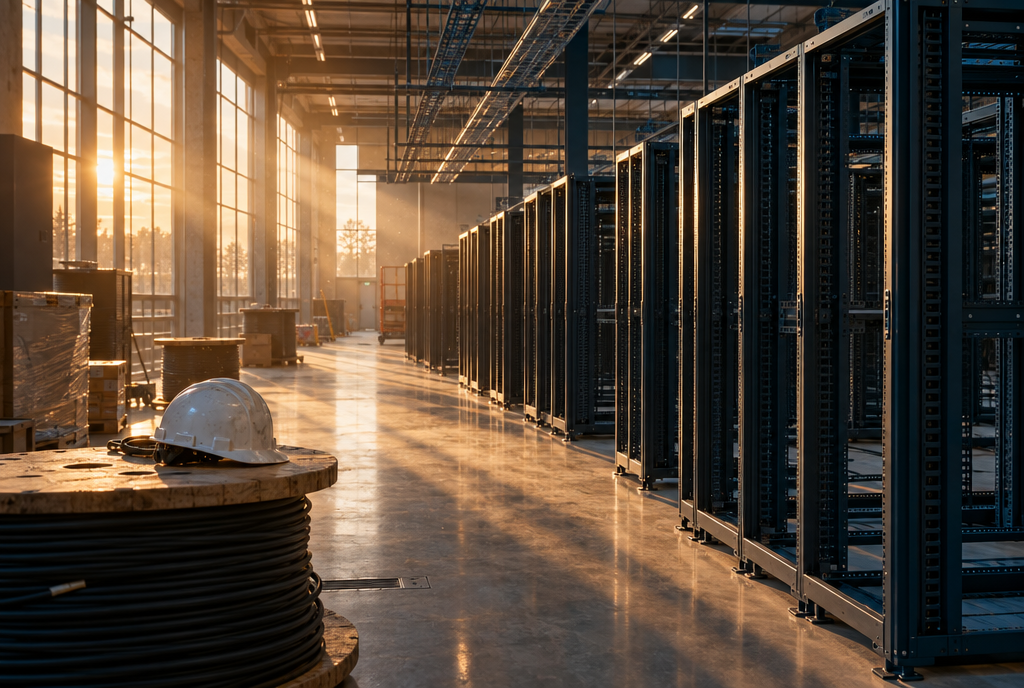
Every conversation about artificial intelligence eventually arrives at the same unglamorous place: a building full of servers, power lines and cooling pipes. Models get the headlines, but the training and inference behind them happen in physical data centers that someone has to design, build, power and maintain. And while the AI companies themselves are often funded with equity, the infrastructure underneath them runs to a surprising degree on debt: construction loans, equipment financing and short-term working capital for the contractors and operators who actually pour the concrete and rack the hardware.
This article explains why that is, how the chain of demand works from AI workloads down to electrical capacity, and what it looks like when projects of this kind appear on CrowdHive, a Swiss crowdlending platform supervised by SRO VQF under Article 24 AMLA.
From AI workloads to concrete and copper
The economics of AI infrastructure follow a simple chain. It starts with demand for AI workloads: companies want to train models, run inference for their products, or rent compute to others. That demand translates into demand for GPUs, the specialized chips that do the heavy mathematical lifting.
Here is where the physical world takes over. GPUs are extraordinarily power-dense compared with traditional servers. A rack of conventional IT equipment might draw a few kilowatts; a rack packed with modern GPU systems can draw many times that. Higher power density means two things for the building around it:
- More electrical capacity. The site needs grid connections, transformers, switchgear and backup systems sized for the load. Securing approved capacity from the local utility is often the single hardest part of a project, and sites that already have it are valuable for that reason alone.
- More cooling. Every watt that goes into a chip comes out as heat. High-density GPU halls need engineered cooling, whether high-capacity air systems or liquid cooling, and that equipment is a major share of construction cost.
So the chain looks like this: AI workloads create GPU demand, GPU density creates power and cooling requirements, and power and cooling requirements create capital expenditure. Someone has to finance that capex before a single workload runs. Industry analysts broadly expect global spending on data center construction and equipment to keep growing for years as AI capacity is built out, and a meaningful share of that build-out is financed with borrowed money rather than shareholders' equity.
Why debt, not just equity
At first glance it might seem natural for AI infrastructure to be funded the way AI startups are: sell shares, raise capital, build. In practice, debt dominates large parts of the infrastructure layer, for reasons that are structural rather than fashionable.
Infrastructure produces contract-backed cash flows
A data center operator typically signs agreements with clients before or during construction. An engineering and construction contractor works against a signed contract with milestone payments. In both cases, the future cash flows are relatively defined: they come from contracts, not from hopes about market adoption. Lenders can underwrite defined cash flows. Equity investors are needed where outcomes are open-ended; debt fits where the question is mostly execution and timing.
Owners do not want to give the business away
For a contractor or a regional operator, raising equity means permanently selling a share of a company whose value they expect to grow. Borrowing for a specific project, repaying from that project's proceeds and keeping full ownership is usually the better trade whenever the cash flows to service the debt are visible in advance.
The money is needed for a defined window
Construction is a phase, not a permanent state. A contractor needs funds to buy materials, hire crews and pre-pay equipment suppliers between signing a contract and receiving the client's milestone payments. An operator building a new module needs capital between ordering cooling and power equipment and the moment client revenue from that module starts flowing. This is precisely the shape of a short-term loan: money in for months, not decades, repaid when the contracted payments arrive.
Why contractors and operators borrow short against contracts
This timing logic explains a pattern you will see in real projects: relatively short loans, often structured as bullet loans, where the borrower pays interest during the term and returns the principal in one payment at the end. That structure matches construction reality. During the build phase the borrower has costs and no project revenue; when the client pays for the completed stage, or the finished asset is handed over, the lump sum arrives and the principal can be repaid at once. We cover the mechanics and the risks of this structure in detail in our guide to bullet loans.
The key point for an investor is that repayment in these projects is anchored to something specific: a signed construction contract with stage payments, an offtake or purchase agreement for a finished facility, or revenue from clients already committed to the capacity being built. That anchor is what due diligence has to verify.
What this looks like on CrowdHive
Several of the first projects on CrowdHive come exactly from this corner of the economy, and they illustrate the categories well. As always, we describe borrowers by category rather than by name.
An EPC contractor building a data hall. One project involves a Brazilian engineering and construction contractor with several years of data center experience, working under a signed contract to build a new data hall of roughly 1 MW of IT capacity, including high-density GPU infrastructure, at an operating data center site. The loan finances the working capital of the build, and repayment is tied to the client's stage payments under the existing contract. The contractor is not speculating on AI demand; it is executing a contract that already exists.
A data center operator adding an AI/GPU module. Another category is the operator itself: a B2B IT integrator building its own data center facility in Paraguay, with utility pre-approval for its power capacity, developing a dedicated high-density module for client AI and GPU systems. Here the loan bridges the gap between equipping the module and the client revenue it is built to serve. Paraguay is a notable location for this kind of project because of its abundant hydroelectric power, and the broader regional context is part of why yields on Latin American projects reach the levels they do.
Projects in these categories on the platform are structured as bullet loans at 17% per year, with monthly interest during the term and principal at maturity, and terms measured in months rather than years.
Repayment in these projects is anchored to something specific: a signed contract, a purchase agreement, or committed client revenue. That anchor is what due diligence has to verify.
What to look at as an investor
Debt-financed AI infrastructure can be attractive precisely because repayment is contract-anchored, but that only holds if the anchor is real. Before investing in a project of this type, it is worth asking:
- What exactly repays the loan? A signed contract with stage payments, a purchase agreement for the finished asset, or committed client revenue are strong answers. "Future demand for AI" on its own is not.
- Who is the counterparty behind that cash flow? A contractor's loan is only as good as the client paying the milestones. An operator's module is only as good as the clients committed to using it.
- Is the power secured? For data center projects, approved utility capacity is the scarce resource. A site with documented pre-approval is fundamentally different from a site that still needs it.
- Does the timeline match the loan term? A bullet loan works when the repayment event, the milestone payment or handover, falls inside the loan term with a margin for delay. Construction delays are common; the structure should tolerate them.
- What secures the loan? Collateral-backed lending means there is an asset to pursue if the contracted payments fail. On CrowdHive, BellaVista Invest One AG acts as Collateral Agent and conducts recovery on behalf of investors, so an individual investor does not go to court alone.
Every project that reaches the CrowdHive feed goes through full due diligence first: who owns the business, what its accounts actually show, which customers and suppliers it depends on, and how it generates the cash to repay. You can read how that process works step by step in our article on CrowdHive due diligence.
The bottom line
The AI boom is, at the ground level, a construction boom, and construction has always run on credit. Contractors borrow against signed contracts; operators borrow against committed capacity; developers borrow against purchase agreements for finished sites. For investors, this creates access to short-term, contract-anchored lending in one of the fastest-growing corners of the real economy, with returns on CrowdHive projects in this category at 17% per year. The discipline is the same as with any crowdlending investment: understand what repays the loan, who stands behind that payment, and what happens if it is late.
Investing involves risk, including the possible loss of capital. Past performance is not indicative of future results. BellaVista Invest One AG facilitates lending to businesses and does not provide investment advice.